
Vad kostar det? How to Shop and Pay in Swedish
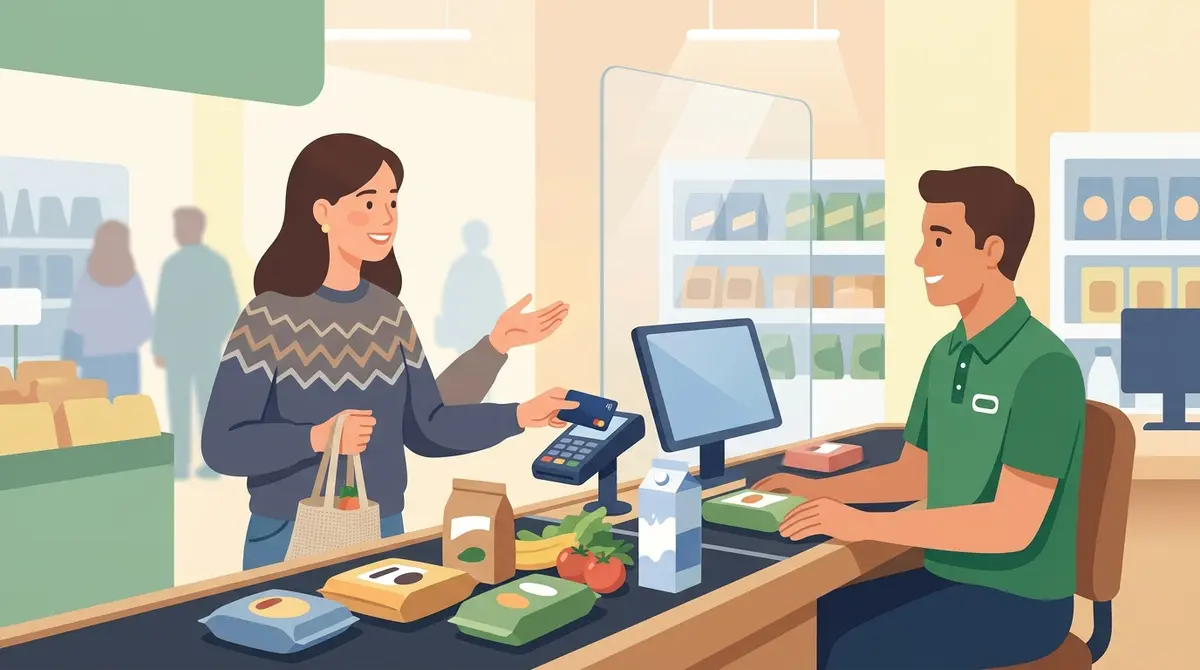
A grocery store or bakery is one of the first places you speak Swedish for real. You need to check a price, get through the checkout and understand what the cashier asks you. A few short phrases cover most of it.
Asking for Prices and Finding Items
When you cannot find a price tag, the most useful phrase is Vad kostar det? (How much does it cost?).
To ask about a specific item, replace det with the noun in its "the" form, or use den här / det här (this) with the "the" form:
- Vad kostar kaffet? (How much does the coffee cost?)
- Vad kostar den här bullen? (How much does this bun cost?)
- Vad kostar äpplena? (How much do the apples cost?)
Notice the verb: att kosta (to cost). In the present tense, it is always kostar.
If you are looking for something and cannot find it, ask:
- Ursäkta, var finns mjölken? (Excuse me, where is the milk?)
- Har ni havremjölk? (Do you have oat milk?) On the carton it says havredryck.
Smaller shops often post their opening hours on the door. You can learn those words in our guide to Swedish door and store signs.
At the Checkout: Three Common Questions
At the kassan (the checkout), cashiers in Sweden often ask the same few questions. Here are three you will hear a lot:
-
Vill du ha en påse? (Do you want a bag?) Bags usually cost a few kronor in Swedish shops, so the cashier often asks first. If you brought your own bag, say Nej tack, det är bra (No thanks, I'm fine). If you need one, say Ja tack (Yes please).
-
Betalar du med kort? (Are you paying by card?) Most people in Sweden pay by card. You will hear Betalar du med kort? or simply Kort? (Card?). If you want to pay by card, just say Ja or Ja tack.
-
Vill du ha kvittot? (Do you want the receipt?) Notice the modal verb vill here. You can learn more about it in our guide to Swedish modal verbs. To answer the receipt question:
- Nej tack, det behövs inte. (No thanks, that's not needed.)
- Ja tack, gärna. (Yes please.)
Kvittot is your receipt, on paper or sent to your phone. If you pay cash, the money you get back is växel (change). In big supermarkets the cashier may also ask Är du medlem? (Are you a member?), about the shop's loyalty card. Nej is a fine answer.
Useful Shopping and Paying Vocabulary
Here are the most common words and phrases you will hear and use when shopping in Sweden:
| Swedish | English | Example |
|---|---|---|
| Vad kostar det? | How much does it cost? | Ursäkta, vad kostar det här brödet? (Excuse me, how much does this bread cost?) |
| kassan | the checkout / the till | Du kan betala i kassan. (You can pay at the checkout.) |
| ett kvitto | a receipt | Vill du ha kvittot? (Do you want the receipt?) |
| en påse | a bag | Jag tar gärna en påse. (I'd like a bag, please.) |
| med kort | by card | Kan jag betala med kort? (Can I pay by card?) |
| kontanter | cash | Tar ni kontanter? (Do you take cash?) |
| på rea | on sale | Den här jackan är på rea. (This jacket is on sale.) |
| ett erbjudande | a special offer / deal | Det är ett bra erbjudande. (That is a good offer.) |
Shopping Culture in Sweden: Cards, Swish and Self-Checkout
Sweden is one of the most cashless countries in the world. Many small shops, cafés and museum ticket desks have signs saying Kontantfritt (cash-free) or Vi tar inte emot kontanter (We do not accept cash). You rarely need cash.
People pay by card or with Swish, a phone payment app. You need a Swedish bank account and BankID to use it. At flea markets (loppis) and food trucks, you will often see a phone number or a QR code with the words Swisha här (Pay with Swish here).
Many supermarkets also have självscanning (self-scanning) and snabbkassor (self-checkouts). At a self-checkout, the screen shows a few more words worth knowing: Välj betalsätt (Choose payment method), Sätt in kortet (Insert the card) and Skriv ut kvitto? (Print receipt?).
Quick Practice
Choose the best answer for each situation:
-
You want to ask an employee how much an item costs. What do you say?
- a) Var finns det?
- b) Vad kostar det?
- c) Vill du ha det?
-
The cashier asks: "Vill du ha en påse?" You brought your own backpack and do not need a bag. How do you reply?
- a) Nej tack, det är bra.
- b) Ja tack, gärna.
- c) Ursäkta, jag vet inte.
-
What does a sign reading "Vi tar endast kort" mean?
- a) We do not accept cards.
- b) We only accept cash.
- c) We only accept cards.
Answers
- b) Vad kostar det? (How much does it cost?)
- a) Nej tack, det är bra. (No thanks, I'm fine.)
- c) We only accept cards. (Endast means "only".)
Practise this with Kielo
In Kielo you can practise asking for prices and paying in a conversation, and review these phrases in your daily plan. Prova själv nästa gång du handlar (try it next time you shop): Vad kostar det?
- Learn Swedish
- Swedish Vocabulary
- Shopping and Money
- Swedish Phrases
- Swedish for Beginners
Practise this Swedish with Kielo
AI conversations, short articles at your level and exercises built around your mistakes.
Download Kielo