
Swedish Modal Verbs: How to Use Kan, vill, ska and måste
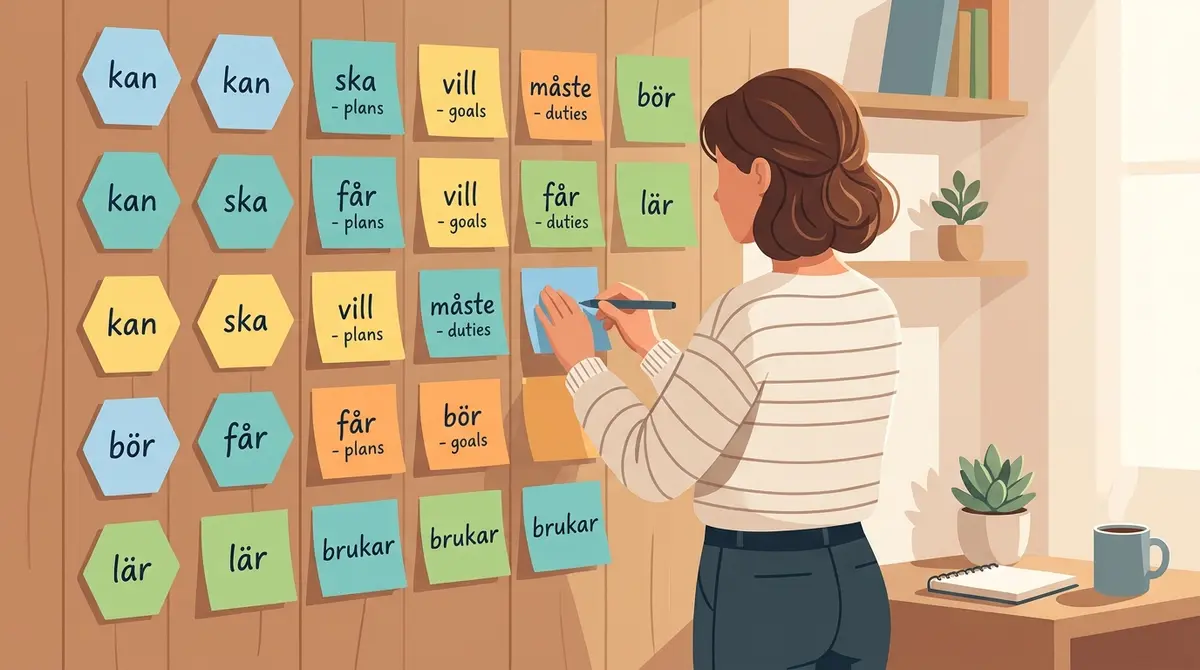
When you first start learning Swedish, conjugating every single verb can feel like slow work. That is why modal verbs are your ultimate shortcut. A modal verb pairs with another verb to show possibility, intention, desire, or obligation. Once you know just four or five simple modal verbs, you can unlock hundreds of natural sentences because the main verb that follows never needs to change its ending.
The Big Four: Kan, vill, ska, and måste
Swedish modal verbs behave very much like their English cousins, but with one huge advantage: Swedish verbs never change depending on the person. Whether it is jag (I), du (you), or vi (we), the verb stays exactly the same.
Here are the four most common modal verbs you will use every day:
- kan (can, be able to): Jag kan prata lite svenska. (I can speak a little Swedish.)
- vill (want to): Vi vill fika nu. (We want to have coffee now.)
- ska (will, are going to, shall): Hon ska resa imorgon. (She is going to travel tomorrow.)
- måste (must, have to): Jag måste sova. (I have to sleep.)
Notice the golden rule here: the second verb is always in the basic infinitive form, usually ending in -a, such as prata (to speak), resa (to travel), or sova (to sleep).
The "Att" Trap and Other Common Mistakes
The single biggest trap for English speakers learning Swedish modal verbs is the little word att (to).
In English, we say "I want to eat" and "I have to go." Because of this, learners often want to slip att into Swedish sentences. But in Swedish, modal verbs connect directly to the next verb without any glue word:
- Right: Jag vill äta. (I want to eat.)
- Wrong: Jag vill att äta.
- Right: Jag måste gå. (I have to go.)
- Wrong: Jag måste att gå.
Another common mistake involves wanting an object versus wanting to do an action. When you want an object, use vill ha (want to have):
- Jag vill ha en kaffe. (I want a coffee.)
- Jag vill dricka kaffe. (I want to drink coffee.)
Finally, pay attention to word order. Under the Swedish V2 Rule, your modal verb takes the second position in standard statements. If you put a time word first, the modal verb still comes right after it:
- Nu måste jag gå. (Now I must go / I have to go now.)
Two More Modals: Får and borde
Once you feel comfortable with the basics, add two polite and useful verbs to your toolkit:
-
får (may, be allowed to): Use this to ask for permission or express rules.
- Får jag sitta här? (May I sit here?)
- Man får inte röka här. (You are not allowed to smoke here.)
-
borde (should, ought to): Great for giving gentle advice or expressing reasonable expectations.
- Du borde vila. (You should rest.)
- Vi borde ringa mamma. (We should call mum.)
Handy Swedish Modal Verbs and Phrases
| Swedish | English | Example |
|---|---|---|
| kan | can / be able to | Kan du hjälpa mig? (Can you help me?) |
| vill | want to (do something) | Jag vill lära mig svenska. (I want to learn Swedish.) |
| vill ha | want (an object) | Vill du ha en bulle? (Do you want a bun?) |
| ska | will / going to | Vad ska vi göra ikväll? (What are we going to do tonight?) |
| måste | must / have to | Han måste arbeta idag. (He has to work today.) |
| får | may / be allowed to | Får man parkera här? (May one park here?) |
| borde | should / ought to | Jag borde träna mer. (I should exercise more.) |
| hinner | have time to | Hinner du dricka te? (Do you have time to drink tea?) |
Modals in Swedish Daily Life
Swedish culture leans heavily towards social balance, mutual respect, and polite understatement. You will notice that Swedes rarely use harsh commands. Instead of saying Gör det här! (Do this!), colleagues and friends will almost always soften their sentences using modals: Kan du göra det här? (Can you do this?) or Borde vi titta på det? (Should we look at that?).
You will also hear modal verbs constantly during social rituals. At work, someone stepping away from their desk might say, Jag måste ta en paus (I must take a break) or invite a colleague by asking, Ska vi ta en fika? (Shall we have a coffee break?).
Notice how inviting ska vi sounds compared to a direct statement. It invites collaboration, which is a cornerstone of Swedish communication.
Quick Practice
Test your new knowledge with these three short exercises. Choose or write the correct Swedish words, then check your answers below.
- Translate into Swedish: "We want to go home."
- Fill in the blank (can / be able to): ____ du tala engelska?
- Choose the correct sentence:
- A) Jag måste att studera ikväll.
- B) Jag måste studera ikväll.
Answers:
- Vi vill gå hem. (Remember: no att!)
- Kan (Kan du tala engelska?)
- B is correct. In Swedish, modal verbs never take att before the following infinitive.
Practise this with Kielo
You can practise building sentences with kan, vill, and ska in your next Kielo interactive chat, where you will receive instant feedback on word order. Add these modal verbs to your daily review plan so you can pull them up without hesitation in real conversations. Vad vill du göra idag? (What do you want to do today?)
- Learn Swedish
- Swedish Verbs
- Swedish Grammar
- Swedish Vocabulary
- Verb Basics
Practise this Swedish with Kielo
AI conversations, short articles at your level and exercises built around your mistakes.
Download Kielo